Beneath the Crust: A Volcanic Discovery!

Match the natural objects with their geometric shapes to discover nature’s hidden math!

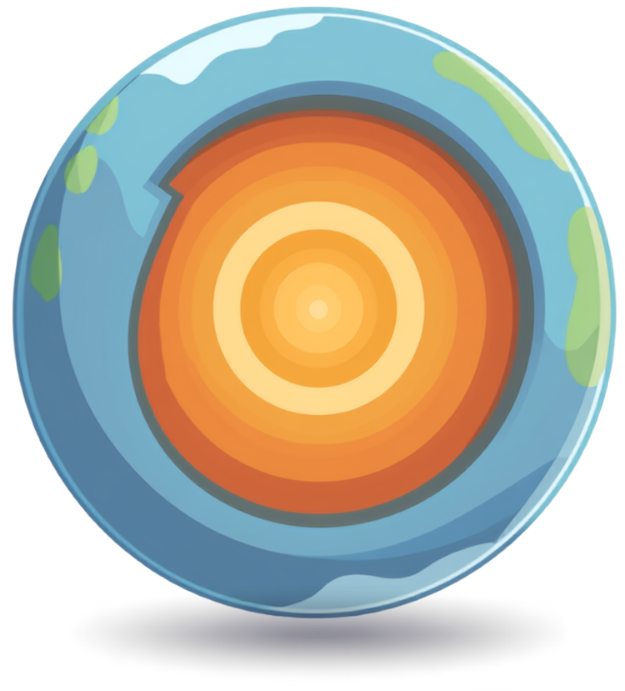
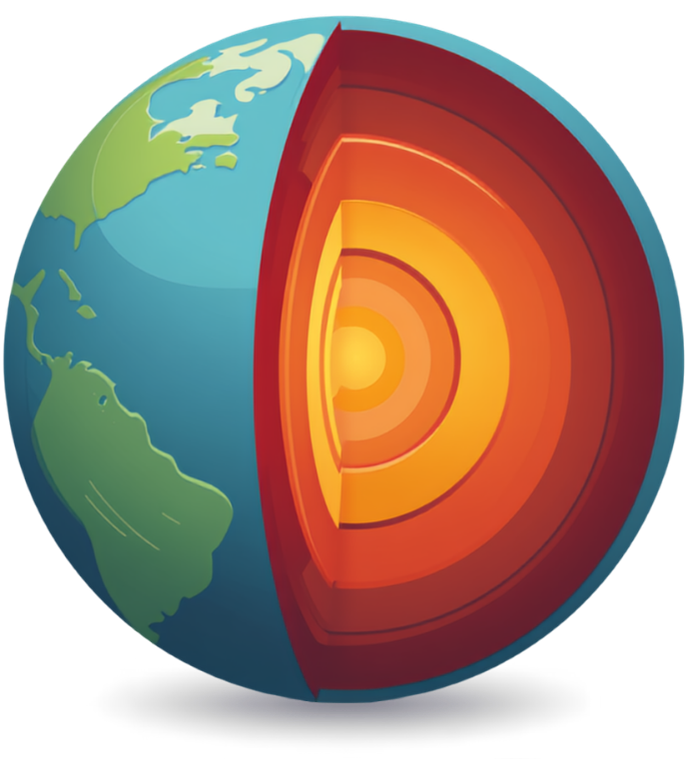
Crust

Mantle

Outer
Core

Inner
Core

One rainy afternoon, I was watching TV when a news report showed a mountain glowing with fire and smoke. My eyes widened in surprise. Sitting next to me, Eli noticed my expression and asked, “Riri, have you ever seen a volcano before?
I turned to her, puzzled. I said, “Wait, the mountain is a volcano? What is a volcano?” Eli’s wings fluttered with excitement. “Come on! Let’s visit Professor Poki—he’ll explain everything.”
We rushed through the misty forest to a giant tree with a small bell on the door. Eli tapped it with her beak. A familiar voice called out, “Who’s there?” “It’s Eli—and I brought Riri!” she replied. The door creaked open, and Professor Poki greeted us with a big smile.
“Welcome to my lab, where I study Planet Earth!” He led us down a spiral staircase into a magical underground lab filled with gadgets and glowing screens.
I saw a volcano on TV,” I said. “Can you tell me what it really is?” “A volcano! Great. One of the most powerful forces on our planet. Let me show you.”

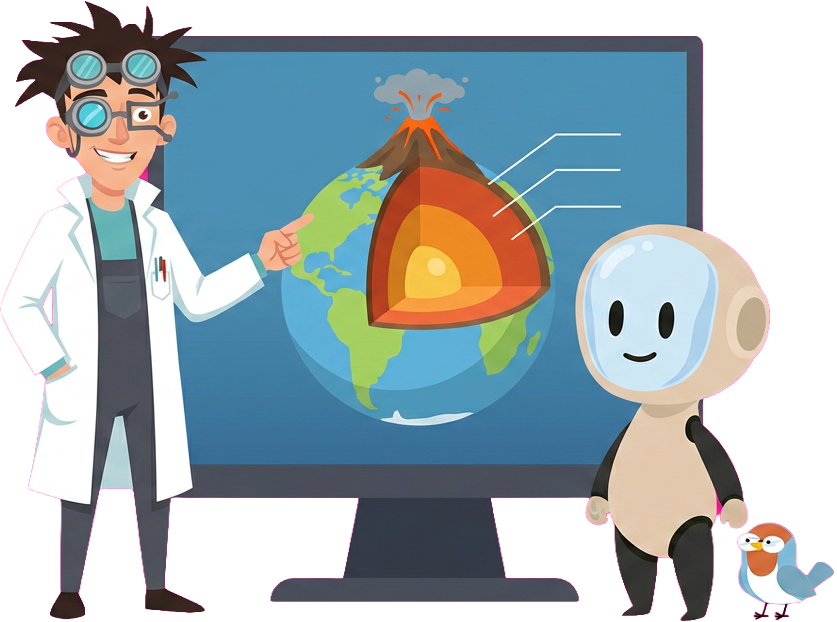
He guided us to a control room that looked like a spaceship. “Strap in,” he said. “We’re going on a journey to the center of the Earth!” The lights dimmed, and the screen lit up.

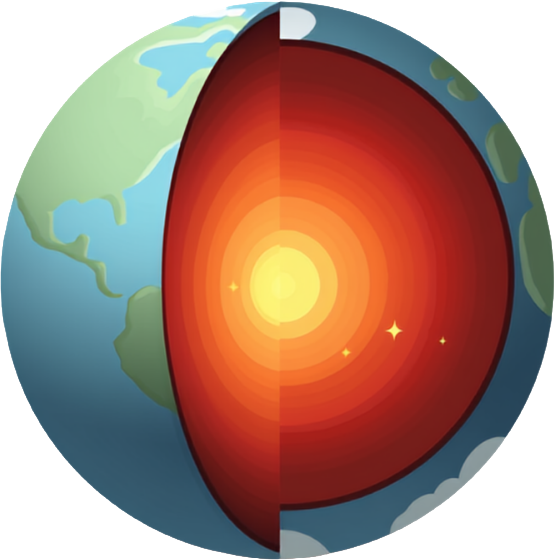
Professor Poki pointed at a 3D model of Earth. “Our planet is made of layers, just like a peach. The center is the core, around that is the mantle, and the outer skin is called the crust.” I listened carefully and watched the images on the big screen showing the planet divided into several layers.

was increasingly curious to know what a volcano was. Unable to stand it any longer, I asked: “And where are the volcanoes?” Professor Poki smiled and said: “Calm down, the volcanoes and the ‘fire’ you saw is a phenomenon that happens on the surface of the planet, on the crust. But the materials come from the layer underneath; in other words, they come from the mantle.
When rocks deep inside the mantle get too hot, they melt into liquid. That hot liquid is called magma.” He continued, “Magma rises through cracks in the crust and erupts on the surface. That’s how volcanoes are born!”
On the screen, we watched magma erupt from a volcano. “Because the crust is on the outside, it is colder and therefore crumbly. It is through these areas where the crust is broken that the MAGMA (the name given to rocks in a liquid state) ends up escaping. Once magma escapes and flows outside, we call it lava.”

Poki raised his arms and said, “Volcanoes appear when, through fractures, MAGMA escapes to the outside of the planet!

Some volcanoes erupt gently, with slow lava flows. Others are explosive —they blast magma into the sky, creating huge clouds filled with tiny lava droplets.” “Those droplets have names, too,” he added. “Ash, if they’re tiny, volcanic bombs, if they’re large. Together, we call them pyroclasts.”
I couldn’t understand and asked, “How tiny and large can they be?” Poki said, “The smallest, less than 2 mm, are ash and the largest, over 6.4 cm, are called volcanic bombs. These particles can travel far with the wind, and eventually fall back to Earth, forming new magmatic rocks as they cool”.

I asked, “How does this work?”. Poki gave more details, “The material expelled by the volcano is at very high temperatures (it can reach 1200ºC). But outside the planet, it will end up cooling and becoming solid, giving rise to these magmatic rocks”.
I was very curious and willing to see a real volcano. I turned to Eli, “Wouldn’t it be amazing to actually see a real volcano?” Eli thought, “Hmm, yes! Maybe we could visit one of those gentle volcanoes in Hawaii and see the lava flows up close. Then, go to Mount Etna in Italy to witness the explosive kind and those flying pyroclasts!”
Professor Poki chuckled, “That would be quite the field trip! You know, many scientists visit volcanoes all over the world to observe eruptions, collect rock samples, and learn how our planet works.” He walked over to a large globe and spun it gently. “Hawaii… Italy… Iceland… There are volcanoes across the globe, each with a different personality”.
And that was the end of our day. Eli said, “Thanks, Poki. We’ll study up, plan our trip, and get ready for the heat!”
Let’s review what we’ve learned! Choose the correct answers.
Well done! Continue to the gate.