Match each inventor trait with its correct description to begin your creative journey!
Curiosity
Perseverance
Creativity
Collaboration
One morning, I was practising my flying skills, spinning my tiny propellers to glide smoothly through the air. But just as I was getting the hang of it—SNAP!—I found myself tangled in a mess of branches.
“Eli!” I called, hoping she could help. Eli fluttered over, assessing the situation. “Riri, I think we need a special lesson today,” she said thoughtfully. “How about we learn about inventors?” As she carefully tried to untangle me, she explained, “Inventors are people who create new things to solve problems. They see challenges as opportunities.” That got me thinking. If inventors solve problems, could learning about them help us get out of tricky situations like this? Since the topic seemed complicated, we decided to visit Poki who always cleared up any doubts we had.
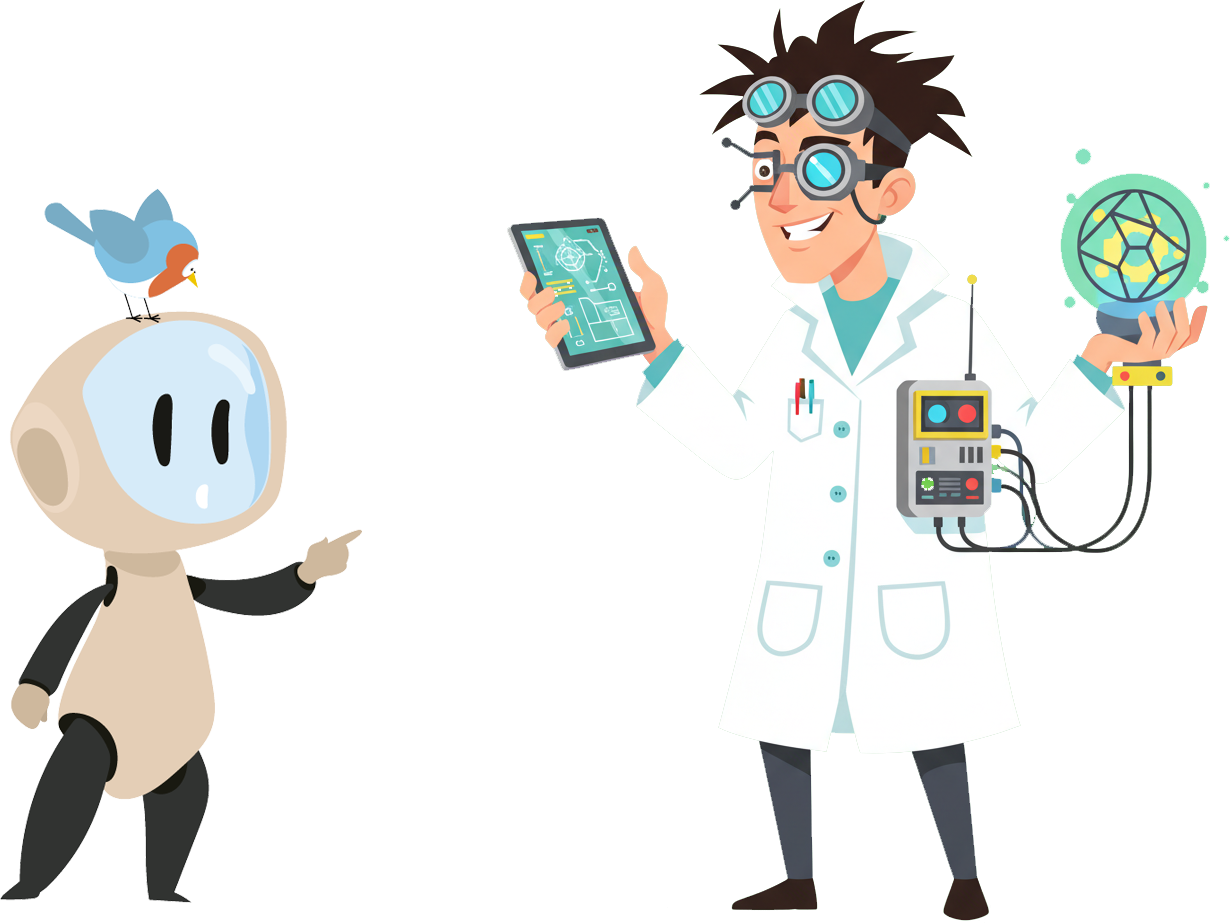
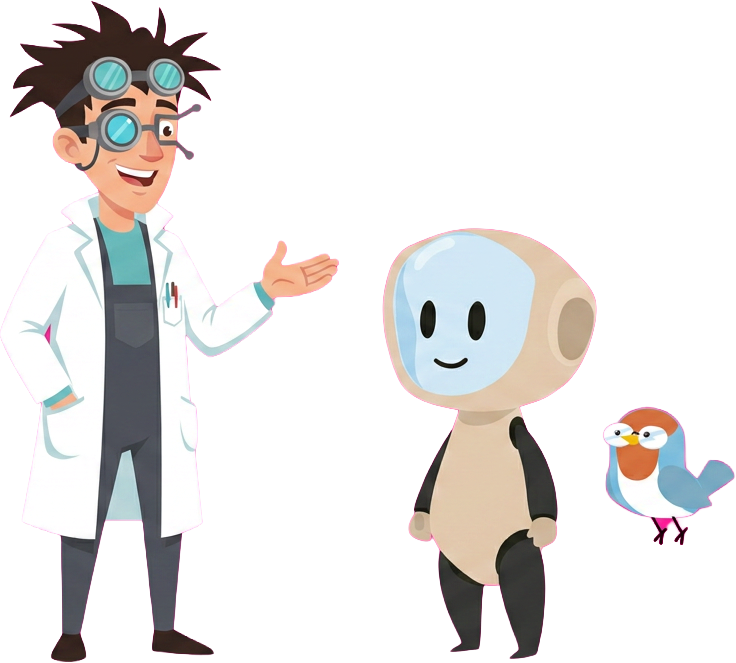
When we got to Poki’s house, Eli told him that we needed to know more about inventors and how they think to come up with their ideas. Then Poki told us: “To understand inventors, you need to know three of their key traits: curiosity, perseverance, and creativity.”
I leaned in. “So, inventors are always asking questions, never give up, and think of new solutions?” “Exactly!” Poki said. “But the best way to learn is by solving a problem—just like real inventors do!” Intrigued, Eli and I eagerly awaited the challenge.
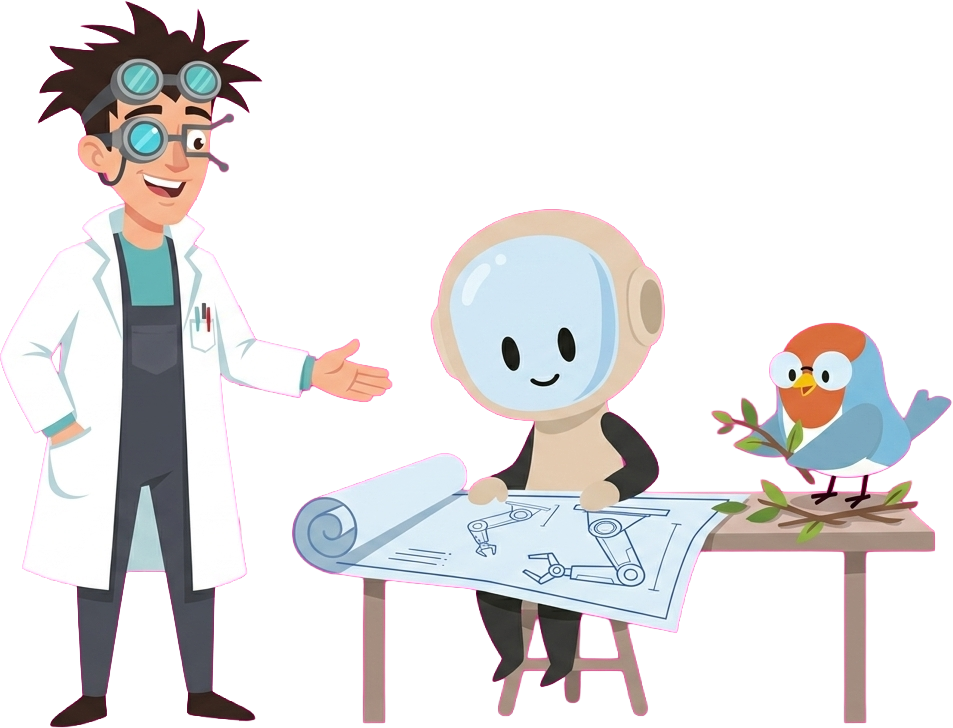
Poki pointed out a broken branch where many birds used to perch. And he said, “The challenge is simple: invent a solution so that the birds can rest there again”. At that moment, I took out a notebook and started to draw a complicated diagram full of lines, until in the end it looked like a robotic arm.
Eli, on the other hand, thought of using leaves to weave a small temporary nest. But when we tried to put together what we had thought of, we realized that the two ideas didn’t work together. So, we asked Poki, “What do we do now?”. Poki smiled. “Remember, an inventor doesn’t give up when faced with a problem. Instead, they look at things differently and work together to create something new.”
At that moment, we looked at our plans and began to discuss how to combine the two ideas. Suddenly, Eli said to me, “What if your robotic arm puts the leaves on the branch?” At that moment, my brain, full of wires, lit up, and I told her, “That’s brilliant!”
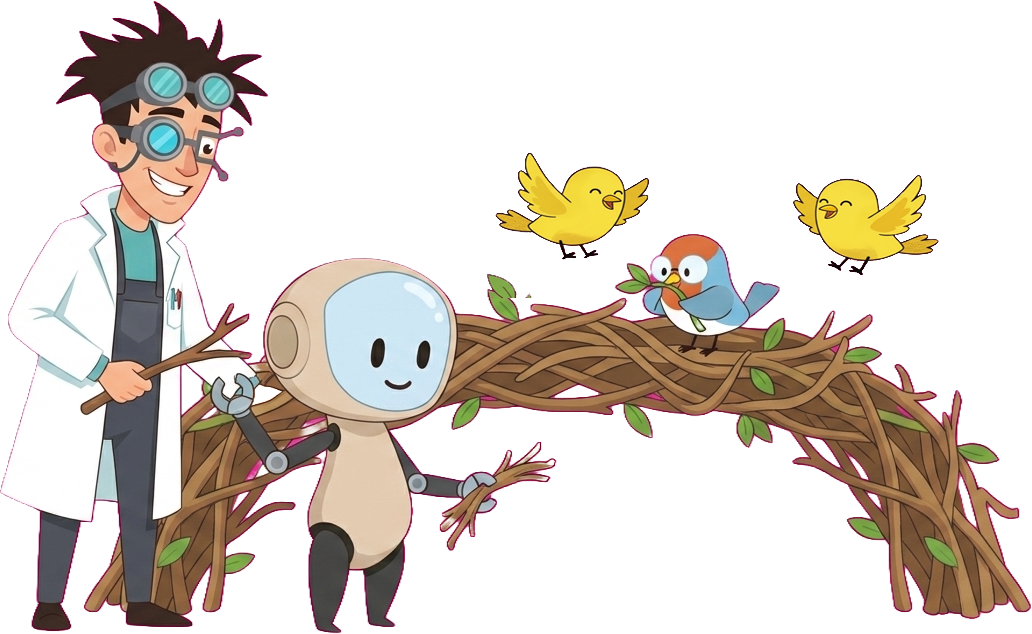
And with my propellers, I can test the structure’s stability from different angles!” After hours of work, tests and adjustments, we managed to create a sturdy bridge-nest. I assembled it with robotic precision, while Eli collected leaves to reinforce it. Finally, a group of birds perched on our invention, chirping happily.
“We did it!”, we exclaimed at the same time. Poki looked at us and with his wise eyes, he said, “Excellent teamwork! Now, tell me—what have you learned about inventors?”
Eli fluffed her feathers, “Inventors are curious and always looking for new solutions.” I added, “And they don’t give up, even when something doesn’t work at first”. Professor said, “Exactly! But most importantly, inventors work best when they collaborate and combine their ideas.”
That night, as the stars twinkled in the sky, Eli and I were resting under the tree, looking at the masterpiece we had managed to make, full of birds. “Thanks for today’s lesson, Eli. Inventors are amazing,” I said. “And you, Riri, you have everything it takes to be one,” Eli replied.
From then on, whenever we faced a problem, we remembered Poki’s words: think like inventors and never stop learning.