Match each object or term with its correct description to begin your journey!
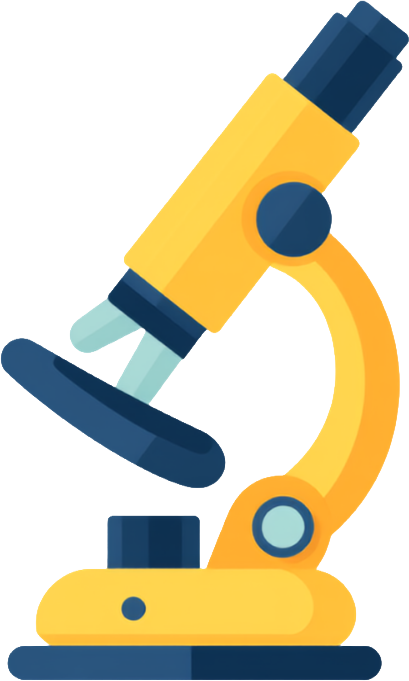
Microscope
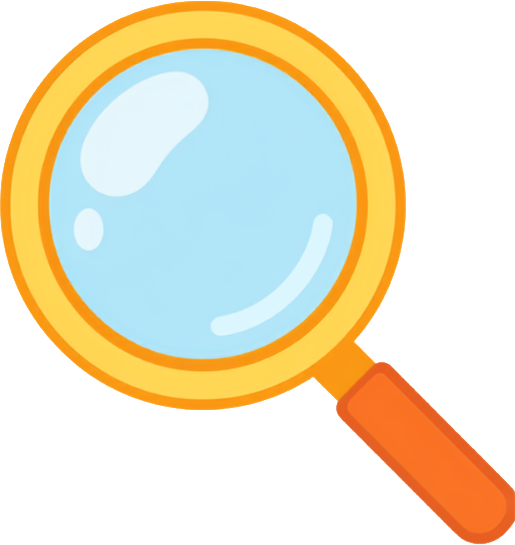
Lens
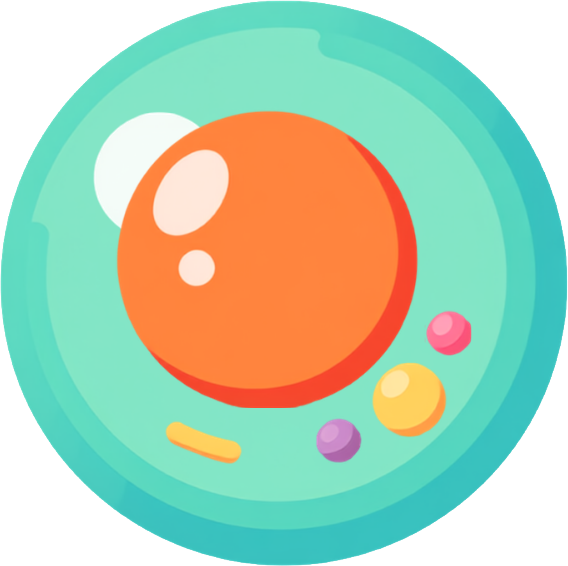
Cell
Microorganism
Eli was excited because today we had decided to explore something completely new. I had recently heard about microscopy and how it could reveal an invisible world that had always been around us but hidden from our eyes.
Was it really possible to see things we never noticed before? Sensing my curiosity, Eli suggested, “Let’s visit Poki! He has a microscope and knows how to use it. I’m sure he can show us this hidden world.”
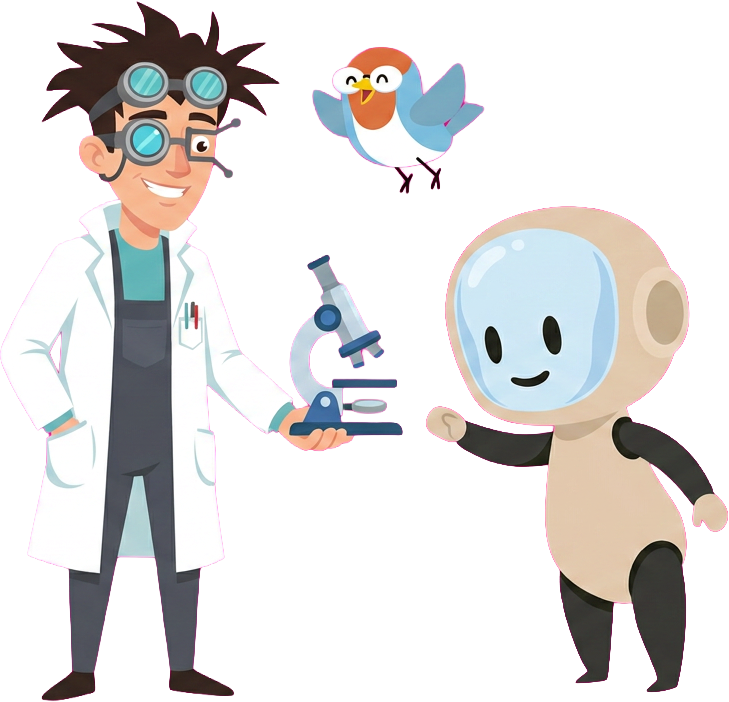
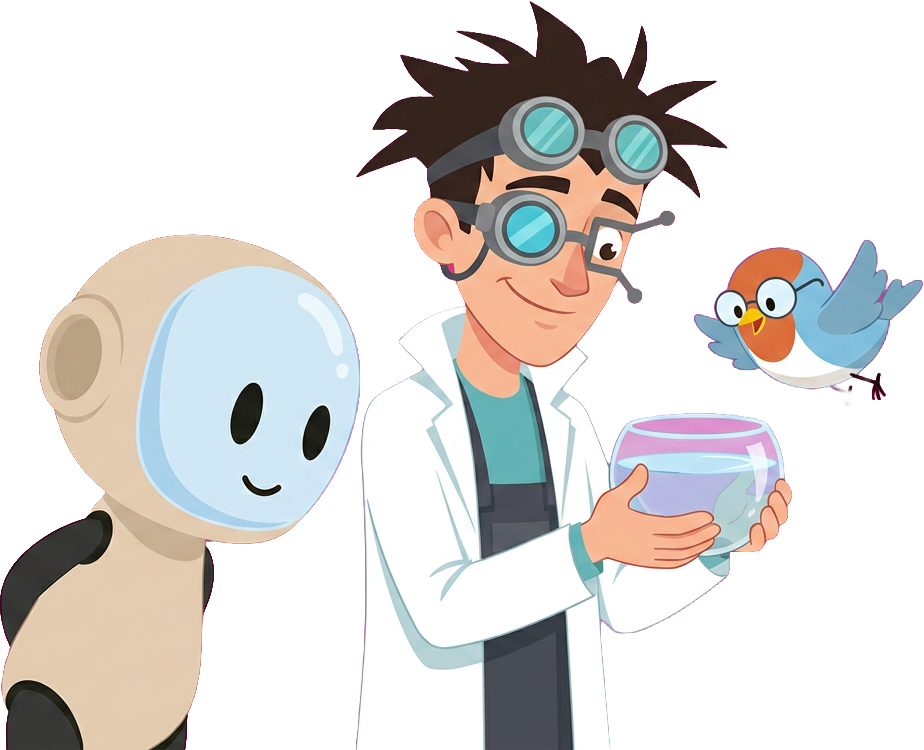
My circuits buzzed with excitement because every visit to Poki meant learning something new. When we arrived, we found him carefully organizing his books. Eli said, “Poki, today we want to learn about the invisible world and microscopy!”. Poki looked at me, and a warm smile spread across his face. “That’s a fantastic topic!” he said
He set his books aside and explained, “Microscopy allows us to see things far too small for the human eye. Did you know there are living organisms so tiny that they are invisible without a microscope?” I found that astonishing. “Really? That’s incredible! But how does a microscope actually work?”
“The key is light,” he explained. “A microscope uses lenses to magnify small objects and reveal details that would otherwise be lost to us. There are optical microscopes, which use visible light, and electron microscopes, which use electrons to produce extremely detailed images.” Both Eli and I listened intently, fascinated by what we were hearing.
Then Eli, ever eager for practical learning, asked, “Poki, can we use a microscope to see something right now?” Poki started searching through his collection of tools. A moment later, he pulled out a small microscope. “Of course! Let’s do an experiment. But first, we need a sample to examine. What would you like to see?”
I thought for a moment and then suggested, “How about a leaf? I’ve always found them fascinating with their different patterns and shapes.” Eli agreed enthusiastically, and together, we gathered leaves from various plants in the forest
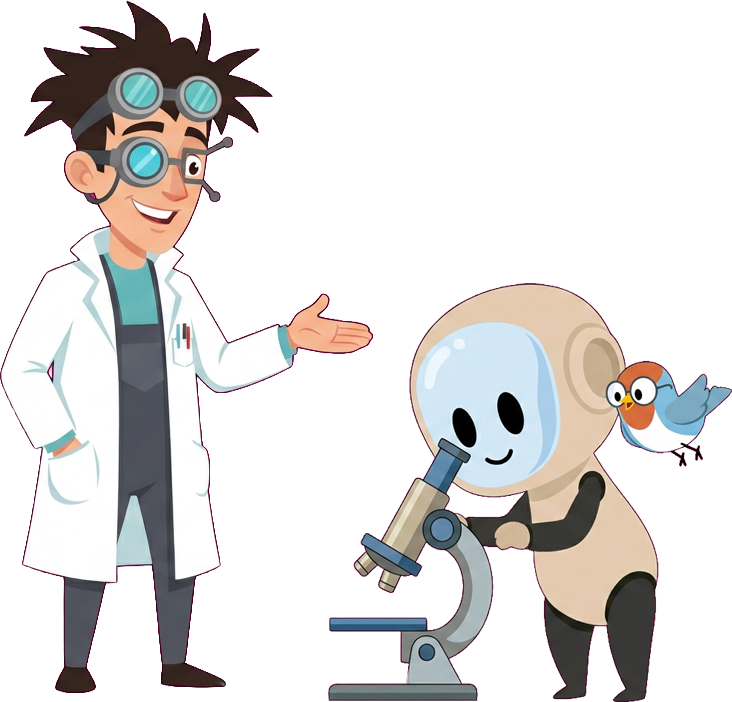
When we returned, Poki demonstrated how to place a leaf under the microscope. “Now, look through the eyepieces,” he instructed. Eli and I peered through the lenses, and what we saw left us speechless. “I can’t believe it!” Eli gasped. “The veins of the leaf look like a network of tiny roads!” Poki nodded. “Exactly! Those veins transport water and nutrients, just like highways for the plant. And see those tiny green structures? Those are cells filled with chlorophyll, which allows plants to perform photosynthesis.” I was completely mesmerized. “Each leaf is a miniature world!”
I wondered what other secrets there might be in the invisible world. And as if Poki had read my mind, he said to me: “There is still so much to discover. For example, did you know microorganisms, such as bacteria, are essential to our ecosystems? They come in different shapes—spheres, rods, and spirals—and they exist everywhere: in the soil, in the air, and even inside our own bodies.”
‘Let’s go and see them!‘ Eli suggested enthusiastically. “We can collect some water from a nearby pond and see what’s inside.” We eagerly set out, filling a small bowl with water from the pond. Holding it up to the light, we could already see tiny movements within it. Poki placed a drop of the pond water under the microscope. “Look closely,” he said. As we peered through the lenses, we saw tiny creatures swimming, twisting, and darting around.
“They’re protozoa,” Poki explained. “Single-celled organisms that play an essential role in the aquatic food chain. Some of them help clean the water, while others are food for larger creatures.”
Amazingly Eli said, “It’s incredible to think that all this life exists around us, and we don’t even realize it.” I couldn’t agree more. Something as simple as a drop of water contained an entire world teeming with life.
Remember that science is full of mysteries waiting to be discovered. Microscope is just one of the tools that allows us to explore what we normally can’t see,” Poki told us at the end of the day
Eli and I, our hearts overflowing with wonder and curiosity, were left wondering what we could explore the next day. The truth is that the adventure has only just begun!