HUMAN AND ARTIFICIAL INTELLIGENCE
Before the story, let’s check what we already know about AI!
Well done! Continue to the gate.
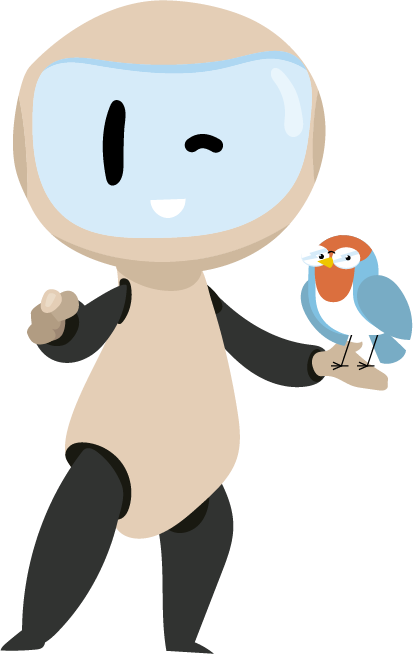
One day, I found myself in Eli’s workshop, surrounded by tools, gadgets, and blinking screens. My eyes were drawn to a sleek device labeled “AI Prototype.”
It buzzed softly, displaying patterns that changed with every click. “Hello, Riri!” Eli greeted, perching on the table. “What catches your eye today?” “That AI Prototype,” I replied. “I’ve heard people talk about Artificial Intelligence, but I don’t really understand what it does. Can AI really think like humans?”
Eli chuckled. “That’s a fantastic question, Riri! Let’s explore it together.”
Eli began, “AI doesn’t think exactly like humans, but it can process data and learn from it. For example, think about voice assistants like the ones on phones—they recognize speech and respond to questions.”
I asked, “That’s amazing! But how do they learn to do that?”. “AI uses something called machine learning,” Eli explained. “It’s like teaching a robot by giving it lots of examples. For instance, an AI learns to recognize a cat by analyzing thousands of pictures of cats. The more it sees, the better it gets at identifying cats!” “That’s so clever!” I exclaimed, but I couldn’t shake a thought.
“Eli, if AI is so powerful, won’t it replace humans someday? Won’t people lose their jobs because of AI?” Eli tilted his head. “That’s a common concern, Riri. But while AI can automate repetitive tasks, it also creates new opportunities. For example, doctors use AI to analyze medical images faster, allowing them to focus on treating patients. It’s more of a tool than a replacement.”
I thought about this and frowned. “But what if AI makes mistakes? What if it harms people instead of helping them?”

“That’s why AI must be designed responsibly,” Eli said seriously. “AI isn’t perfect; it learns from the data it’s given. If the data is biased, the AI’s decisions can also be biased. It’s up to humans to make sure AI is fair and ethical.”

I nodded, beginning to understand. “So, AI is like a powerful machine that needs guidance from people to be helpful?”
“Exactly! Think about self-driving cars,” Eli said. “AI helps them navigate, but engineers must ensure they follow safety rules to protect passengers and pedestrians. AI is a partnership between technology and human oversight.”
As Eli spoke, I started to feel less worried and more inspired. “Wow, Eli. AI isn’t just about making life easier—it’s about collaboration between humans and technology to solve big problems!”
Eli smiled. “That’s right, Riri. AI is being used to predict natural disasters, improve education, and even fight diseases. Its potential is enormous, but it needs people to guide it in the right direction.”

“Do you think robots like me are a part of this AI technology, Eli? Could I help it grow in a way that benefits everyone?”

“Absolutely, Riri! With your curiosity and determination, you could design AI systems that make the world better. Remember, technology is only as good as the purpose it’s built for,” Eli said encouragingly.
“As I looked around the workshop, I felt inspired. My journey on Earth was just beginning, and I was ready to learn more about AI and how I could help create a better future.
Now that we’ve read the story, let’s see what we remember!
Well done! Continue to the gate.