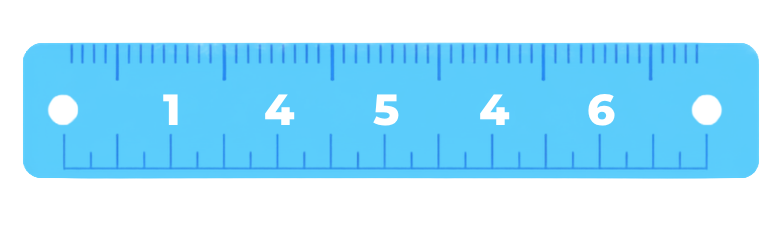
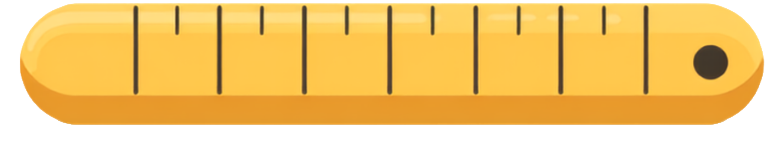
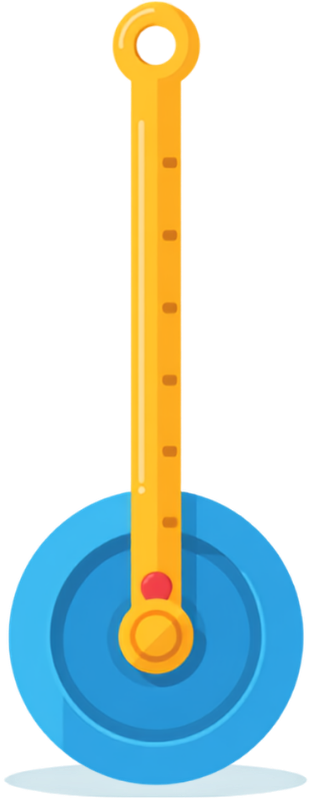
Match the measuring tools with their names to open the Science Yard!
Ruler
Meter Stick
Measuring Tape
Measuring Wheel
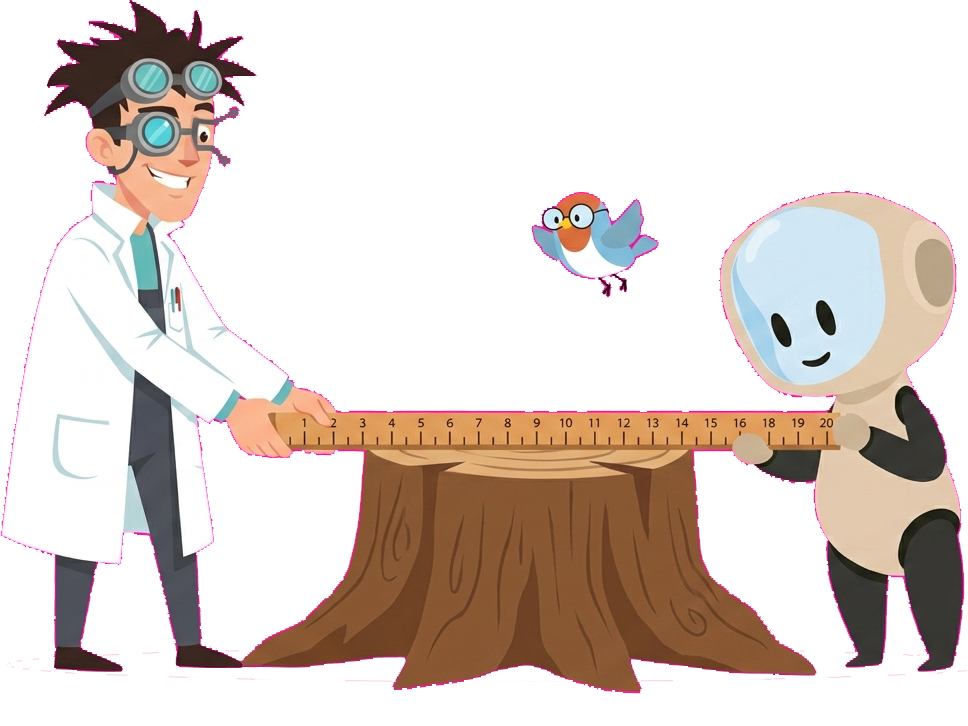
One bright morning, Eli and I set off on a journey to Measuring Valley, a place where explorers learned how to measure the world around them. We were greeted by Professor Poki, a cheerful mathematician holding a long measuring stick, as we arrived. “Welcome to Measuring Valley!” he said, twirling the stick. “Today, we’ll explore how to measure length using different tools and units.”
I looked around and saw ropes, rulers, and measuring tapes scattered across the valley. I turned to Eli and whispered, “What’s length, Eli?”. She said, “Length is one of the fundamental measurements. It helps us understand how long or tall things are, whether small as a pencil or tall as a tree.” Professor Poki’s eyes sparkled. “Exactly, Eli! Your wisdom never ceases to amaze me. Let’s start measuring!”
Poki led us to a table filled with rulers and measuring tapes. “To measure something, we need a unit,” he explained. “A unit is a standard size we use to compare things, like centimetres or meters.” He handed me a ruler. “This shows centimetres,” he said. I measured the notebook. “It’s 25 centimetres long!” I said. “Exactly!” Poki replied. “Centimeters are great for measuring small objects.”
Next, Poki pointed to a flagpole nearby. “How tall is the pole?” he asked. I frowned at the ruler. “The ruler is too short,” I said. Poki nodded. “For tall things, we use meters.” Eli added, “Sometimes even kilometres for larger things, right?” Professor nodded and handed me a measuring tape. I unrolled the tape and measured the flagpole. “It’s three meters tall!” I said
As we walked along the valley, we reached a stream with stepping stones. “How wide is the stream?” Poki asked. I held the measuring tape, but the wind made it hard to stretch it across the stream. “This isn’t working!” I said, frustrated. Poki laughed, “When one method doesn’t work, inventors find another way.”
Eli hopped along the stepping stones, counting each jump. “If we can’t use the tape, let’s measure it using a consistent unit. My steps are always the same length.” I watched as Eli counted her jumps. “It’s eight jumps wide!” she announced. I considered her method. “We could use your jumps as a temporary unit.”
Poki smiled. “That’s clever, but not everyone has the same size jump. For standard measurements, let’s use this measuring stick.” We placed the stick end-to-end across the stream, counting each length. “It’s five meters wide!” I said, smiling.
On our way back, Poki pointed to a row of logs stacked neatly by a woodworking station. “Let’s measure these,” he suggested. I measured a small log with the ruler. “It’s 60 centimetres,” I said. Eli flapped her wings. “What about the biggest one?” Poki and I used the measuring tape and found it was four meters long. “Logs like these are used to build houses,” Poki explained. “Measuring helps us plan and use materials wisely.”
Finally, we reached a garden with evenly spaced plants. “How far apart are the plants?” Poki asked. I measured with the stick and found each plant was one meter apart. “Spacing is important for plants to grow well,” Poki said. And Eli added, “It gives them enough room to breathe and stretch.
As the sun began to set, Eli and I returned to the starting line with Poki. “You’ve measured so many things today,” Poki said. “Length is all about understanding the size of the world around us.” I was excited, “I love how measuring makes things easier to understand!” Eli chirped, “Next time, can we measure something even bigger?” Poki laughed. “Why not? Math is everywhere, and there’s always more to discover!”
Let’s see what you remember, Explorer! Choose the right measuring tool for each task.